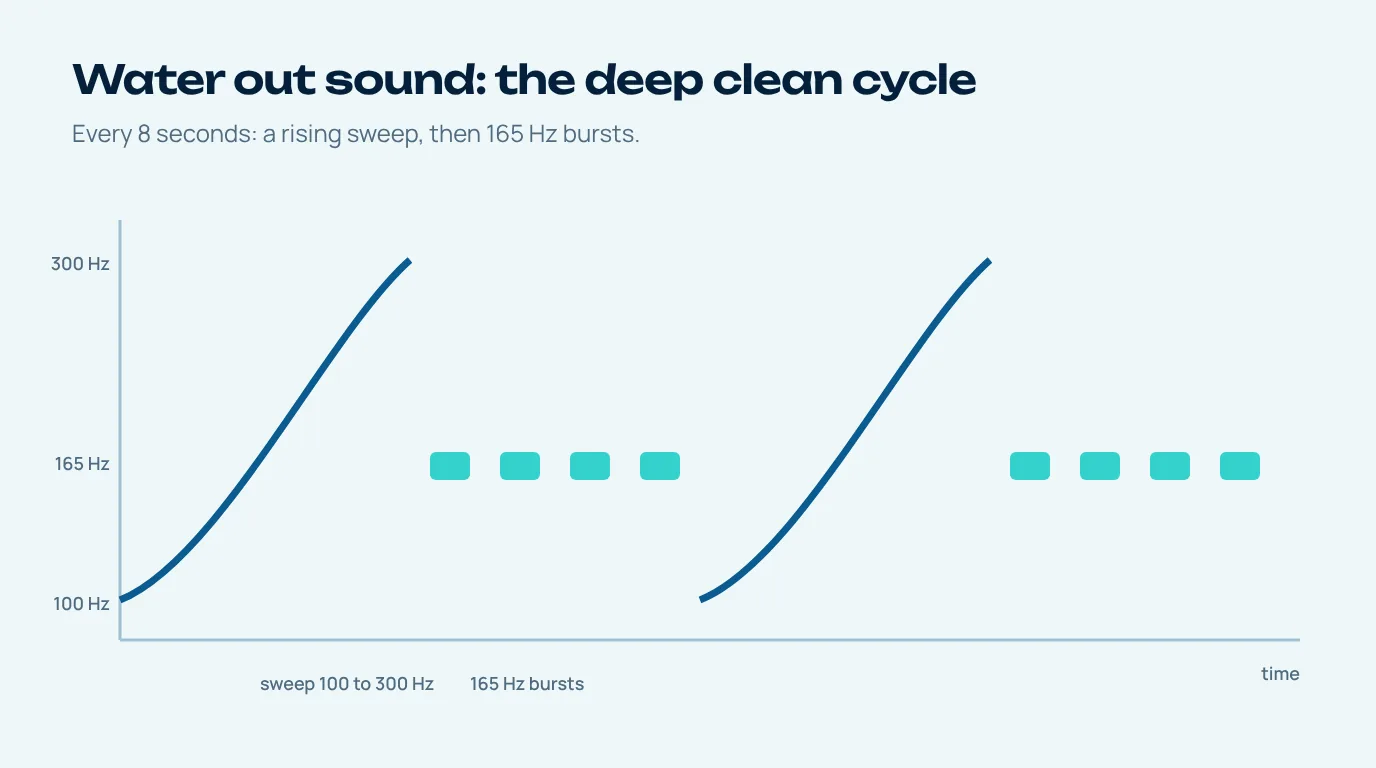
This water out sound starts the tool on Deep clean: a four-second sweep that rises from 100 to 300 Hz, followed by four seconds of 165 Hz bursts, repeating for the whole run. The sweep finds the pitch where your particular speaker moves the most, and the bursts then push hard at the usual sweet spot. Use it as a second pass after the normal water eject tone.
Every phone speaker is built a little differently, with its own size, chamber shape and grille. That means the exact pitch where the diaphragm moves the furthest isn't the same on every model. A single fixed tone works well on most phones, but a sweep has a better chance of hitting the best frequency for yours. That's the idea behind this water out sound.
How the water out sound pattern works
The pattern repeats an eight-second cycle. During the first four seconds the pitch glides upward from 100 Hz to 300 Hz. You'll hear a low growl that rises into a hum. During the next four seconds it switches to 165 Hz and pulses on and off twice a second. Then the cycle starts again.
Why both? Speakers have a resonance, a pitch where they move more easily than at others. Sweeping through a range means the speaker passes through its resonance on every cycle, wherever it happens to be. The bursts afterwards give the trapped water a series of sharp pushes, which is what actually breaks the film across the grille.
Water out sound vs the other patterns
| Pattern | Range | Use it when |
|---|---|---|
| Water remove | 160 to 170 Hz bursts | First run on any wet speaker |
| Vibration | 120 Hz buzz | A rattle or fizz is left behind |
| Deep clean (this page) | 100 to 300 Hz sweep plus 165 Hz bursts | The first run only partly helped |
| Dust | 1 to 6 kHz sweep | The speaker is dry but sounds dull from fine dust |
If you're not sure which to pick, a sensible order is: water remove, then deep clean, then vibration. Most speakers are clear by the second step.
What the water beep sound is (and isn't)
A lot of people search for a "water beep sound" or "water exit sound", often after hearing a clip on social media. Those clips are usually just a low tone like this one, recorded and played back. The trouble with a recorded clip is that video apps compress the audio, and compression can thin out low frequencies, which are exactly the ones that move water. A tone generated live in your browser through the Web Audio API doesn't have that problem.
The other thing to know is that no beep is magic. There's no secret frequency that pulls water out of a phone; the sound simply makes the speaker push air. Phone makers use the same idea: Apple Watch plays a series of tones to push water out of its speaker when you turn off Water Lock (Apple Support).
Getting the most out of a water out run
The basics matter more than the pattern. Volume all the way up. Speaker pointing down. Case off. On iPhone, Silent mode off. Then press Start and leave the phone alone for the full run. I'd also give it a couple of gentle taps against your hand afterwards, connector facing down, which is what Apple suggests for a wet iPhone (Apple Support).
After the run, check the result on the water sound test page. Its frequency sweep goes from 20 Hz to 20 kHz, so you'll hear any remaining buzz at the exact pitch where it happens. If the sweep sounds clean, the water is out.
When the water out sound doesn't help
If two or three runs of different patterns haven't changed anything, the problem probably isn't water in front of the speaker. It could be residue dried on the mesh (from salt water or a drink), lint stuck in the holes, or moisture inside the speaker module. Apple's troubleshooting advice for a blocked speaker opening is to clean it with a small, soft-bristled brush that's clean and dry. Beyond that, a repair shop can test the speaker directly. Our guide on how to remove water from speaker grilles has the full checklist.
Questions people ask
What is a water out sound?
It's a low tone or sweep played through a phone speaker at full volume to push trapped water out of the grille. This page uses a 100 to 300 Hz sweep combined with 165 Hz bursts.
Is the water beep sound from videos the same thing?
Usually it's a recorded low tone. Recorded clips can lose some bass through compression, so a tone generated live in the browser tends to move the speaker more.
Which is better, the sweep or the fixed tone?
Start with the fixed 165 Hz tone. The sweep is a good second pass because it passes through the pitch where your specific speaker moves the most.
How long does the deep clean run take?
The default length is one minute, which is about seven full sweep-and-burst cycles. You can choose 30 seconds or two minutes with the Length buttons.
Can a water out sound damage my phone?
It plays within your phone's normal volume limits and stops on its own, so short runs are fine. Avoid looping it for many minutes, and stop if the speaker makes harsh rattling noises.